
What Being an Ewe Lady Taught Me About Power
My mother never said what she wanted. Neither did I — until I noticed it on my face first.
My mother has a warning she has carried my whole life, passed down the way Ghanaian mothers pass down everything — not as advice, but as law. Don’t marry an Akan man. They are proud, she would say. Too proud. Proud in a way that leaves no room for you. I grew up treating this as background noise, the way you treat the particular fears of mothers who have survived things you haven’t yet. I’ve been sitting with it differently lately. I’ve started to understand what that warning was really about — and what it was saying about us.
I am Ewe. Thursday-born, which in our tradition makes me Yawa. I grew up in Ghana, the daughter of a woman who was the daughter of women before her — all shaped by the same mold: work hard, don’t complain, give generously, want carefully. Humble to a fault. I didn’t have language for it then. I just knew that something about watching my mother move through the world felt like watching someone breathe with one lung.
And yet — that same mother could solve problems with whatever was in front of her, make something from almost nothing, and keep going when most people would stop. The humility and the resourcefulness lived in the same body. That tension is what this essay is about.
It is also about kingdoms, and inheritance, and the difference between power that lives in structures and power that lives in the body. It is about two proud peoples who have never quite liked each other, and what they accidentally share. And it is, ultimately, a Mother’s Day letter — to a woman who taught me more about power than she ever intended to.
The People Who Walked Backwards

To understand the Ewe, you have to start with Notsie.
The Ewe people trace their origin across centuries of migration — from the old Yoruba heartland in what is now Nigeria, westward through Ketu and Tado, until they settled in the walled city of Notsie in present-day Togo. For a time, Notsie was home. But then a king named Agokoli came to power, and home became a trap.
Agokoli is remembered in Ewe oral tradition as a tyrant whose cruelty was almost theatrical in its excess. He forced his people to build the city walls using only their bare hands and feet, mixing mud with shards of glass, rocks, and thorns. He demanded they weave ropes from clay — an impossible task designed to humiliate. Most chillingly, he ordered the killing of elders, as if wisdom itself were a threat to him. He wasn’t wrong about that last part.
The Ewe did what people do when power turns cruel and legitimate exits are closed. They found a side door. The women — always the women — began pouring water against a single section of the city wall each day while washing clothes. Gradually, over time, the mud softened. On the night of the escape, the people gathered and played music, as if celebrating a festival, while an elder named Tegli cut through the weakened wall. And then they walked out — backwards, so their footprints appeared to lead into the city rather than away from it.
They could not leave through the front door. So they softened the wall, disguised their tracks, and walked backwards into freedom.
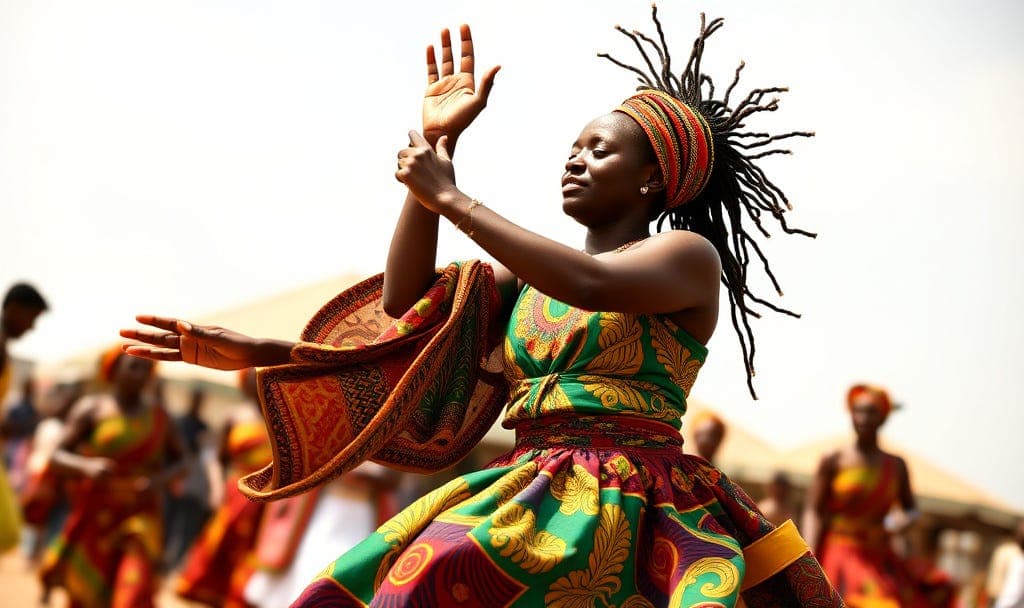
This escape is not merely history. It is identity. Every year, the Hogbetsotso Festival — the Festival of Exodus — celebrates it. Old women demonstrate the backward walk. Chiefs dress in their finest regalia. The whole event pulses with the memory of a people who survived by being clever where they could not be loud.
This is the inheritance that runs deepest in Ewe culture — and in Ewe women especially. Constrained resources, impossible tasks, walls that won’t move. And then: ingenuity. Patience. The willingness to work a problem from every angle until something gives.
After the escape from Notsie, the Ewe split into three groups and dispersed across what is now Ghana, Togo, and Benin. They never built a single centralized empire. They became a constellation of independent communities — decentralized, self-governing, held together by language and shared memory rather than a throne. That structure shaped everything about how they move through the world: adaptive, communal, resilient without being loud about it.
The Kingdom That Centered Women (Almost)
Now meet the Akan.
Unlike the Ewe, the Akan built something magnificent and centralized. The Ashanti Kingdom rose in the early 18th century under Osei Tutu I, who unified warring factions under a single symbol: the Golden Stool, said to have descended from heaven itself. At its height, the Ashanti Empire controlled vast swaths of what is now Ghana and Côte d’Ivoire, commanded formidable armies, and resisted British colonization with a ferocity that colonial records could barely contain.
They also built something remarkable for women — or so it appeared. Akan society is matrilineal: identity, property, and inheritance flow through the mother’s line. An Akan woman’s bloodline is not peripheral — it is the line. The Queen Mother, or Asantehemaa, holds real institutional power: she selects and sponsors candidates for kingship, she presides over matters affecting women, she is not decoration but decision-maker. Every Akan realm has historically been founded by a queen mother. No Ohemaa, no Ohene. No queen mother, no king.
This is why Akan women carry themselves differently. There is a structural permission underneath their confidence — a centuries-old message baked into the society that says: your blood matters, you are central, take up space. It produces women like Yaa Asantewaa — the Queen Mother of Ejisu who, in 1900, stood before a council of chiefs who were hesitating to resist British colonial rule and essentially said: if the men won’t fight, the women will. Then she led the war herself. That is not a woman who was taught to make herself small.
To someone raised outside that structure, Akan women’s confidence can read as arrogance. To someone raised inside it, it is simply the truth they were handed at birth.
My mother, an Ewe woman, sees pride in Akan women. I see women who were told they belong.
But the Uncles Take the Glory
The matrilineal inheritance flows through the woman. But the power is exercised by her brother. The maternal uncle — the wɔfa — is the one who controls family wealth, makes key decisions, holds structural authority. The woman is the vessel of the lineage; the uncle is the executor of it. Her children belong to her clan, not her husband’s. Which also means her husband has reduced structural authority over his own children — his real obligation, in the Akan system, is to his sister’s children, not his own.
It is a system built, in part, around a very old anxiety: in a world before modern certainty, you always knew who the mother was. The father was a question. So wealth passed through the one line you could verify. Logical. Also a system in which women are symbolically powerful and practically managed — central in theory, guided in practice.
The Ewe structure, by contrast, is patrilineal — lineage and inheritance pass through the father. It is at least honest about where power sits. But it is also a structure in which a woman’s identity and security are deeply tied to her husband, and in which the culture reinforces smallness as virtue. Good Ewe women are humble. Humble women are praised. And praised smallness becomes invisible smallness becomes the only thing you know how to be.
Two different structures. Two different promises. And somehow, for women, a ceiling in both.
Two Peoples, One Wound
They have never quite gotten along, these two peoples.
The tension has deep roots — colonial borders that carved the Ewe across three countries (Ghana, Togo, Benin), a 1956 plebiscite in which British Togoland was absorbed into what would become Ghana over the vocal objection of many southern Ewe who wanted reunification with their kin in French Togoland instead. In the south, where the Ewe-majority Togoland Congress campaigned hardest, 55% of voters actually chose separation — but were outvoted by the broader territory. That wound did not heal.
Add to this the reality of Akan political and economic dominance in Ghana since independence — driven by numbers, wealth, and the historical momentum of a powerful empire — and you have a minority group that has always had to be strategically invisible within a country that officially claims them.
And here is the irony that stops me every time: despite the centuries of friction, despite languages so structurally different they belong to separate branches of the Niger-Congo family tree, despite political wounds that still pulse — both peoples name their children by the day of the week they were born. Thursday-born Ewe girls are Yawa. Thursday-born Akan girls are Yaa. The same intuition, dressed in two different tongues. The same belief that the day you arrive in the world says something about who you are.
Neighbors fight and borrow from each other simultaneously. That is the most human thing in the world.
The Fridge
I want to tell you about a fridge.
Growing up, my mother would come back from the market with more than should reasonably fit — a bountiful, overflowing haul that was its own kind of love. And then she would hand the problem to me. Manage the fridge space. No instructions. Just: make it work.
I resented it, honestly. I was a child. But I also always figured it out. I would rearrange, stack, angle things just so, think three moves ahead — and eventually, everything fit. The fridge would close. Problem solved.
That skill followed me. When I hit walls in my career, I rearrange. When a solution doesn’t work, I iterate. When resources are constrained, I experiment until something gives. The willingness to keep going, to try differently, to treat every obstacle as a spatial puzzle with a solution — that came from somewhere. It came from her.
My mother is one of the most resourceful people I know. She accomplished extraordinary things with whatever she had available. Scarcity didn’t stop her; it sharpened her. She built, stretched, managed, endured — and kept producing. That is not a small thing. That is, in fact, a form of power. A form she exercised every single day without ever calling it that.
The Ewe walked out of Notsie with nothing but their wits and each other. My mother walked through her life with a similar toolkit. What looks like making do is actually making something — over and over, without fanfare, without permission, without praise.
The Face Before the Words
Growing up inside a culture that praised smallness, that called restraint virtue and silence dignity, that had no framework for a woman who wanted things loudly — you adapt. You watch the women before you do the same. You learn, as the Ewe learned in Notsie, that when the front door is closed, you find the side door. You soften the wall. You walk backwards.
For many Ewe women, the side door is manipulation. Not cruelty — necessity. You cannot say what you want directly when direct wanting is coded as shameless. So desire goes underground. It leaks out in other ways: in guilt deployed like a weather system, in silences that have texture, in suffering worn so naturally it looks like love. The cage looks like dignity. The reframe is so complete that smallness itself becomes something to be proud of. I know this because I inherited it. An ex once told me something I did not want to hear: You don’t say what you want, but you develop a facial expression that says you are displeased. He was right. I had learned to communicate through a register that was deniable — want without words, feeling without claim. A pattern so old it felt like personality. It wasn’t. It was culture wearing the costume of character.
Inner conflicts are real. The body keeps score on behalf of all the things the mouth was never allowed to say.
The Front Door
Powerlessness does not erase desire. It drives it underground.
This is true for women under patrilineal structures that praise their smallness. It is true for women under matrilineal structures where uncles hold the bag. It is true for a people who had to walk backwards out of a walled city in order to be free. When the legitimate path is closed, desire finds the underground route — in individuals, in families, in whole civilizations.
The work I have done in my own life — learning to say what I want, to hold my ground, to let displeasure live in words rather than on my face — is not self-improvement in the lifestyle-content sense. It is the act of reopening a front door that was closed long before I was born. It is choosing not to pass this particular inheritance forward. It is, in its own small way, a kind of exodus.
My mother warned me away from Akan men because she saw their pride as dangerous. She wasn’t entirely wrong. But she couldn’t fully see that what she called pride in them, I was learning to call permission. The permission to take up space. To want out loud. To believe that your presence in a room is not a problem to be managed.
I am building that permission from scratch, without a structural inheritance to lean on. It is harder than receiving it would have been. It is also more mine.
To Every Woman Who Made It Work

This coming Mother’s Day, I am thinking about all the women who managed.
Who stretched what they had. Who softened walls day by day while appearing to do ordinary things. Who made everything fit in the fridge and never called it genius. Who accomplished extraordinary things with whatever was available, and kept that quiet too.
The Ewe women I know are some of the most resourceful, hardworking, enduring women. They built lives out of scarcity and called it normal. They carried families on their backs and called it love. They walked backwards into freedom and then taught their daughters to be humble about it.
The tragedy is not that they were strong. The tragedy is that they were strong in ways that were never fully named, never fully honored — not by their cultures, not by their structures, and sometimes not even by themselves.
The most powerful thing many Ewe women taught me about power is that they never knew they had it.
So this is for them. For every woman who managed the fridge, the home, the feelings of everyone around her — while her own wants went quietly underground. For every woman whose resourcefulness was recruited by a system that needed her capable but not loud.
You were building something. Even when it felt like just surviving. Even when nobody called it power.
And for the daughters who are still unlearning the backward walk — learning to say what we want, to let displeasure live in words rather than on our faces, to believe our presence is not a problem to be managed: we are continuing their exodus.
And we are just walking out forwards this time.